5 Surprising Costs Behind How Much an F1 Car Does Cost
You might think an F1 car’s cost is all about the engine, but there’s a lot more surprising spending involved. The price tag of an F1 car includes many specialized parts that all add up quickly. It’s not just about power; it’s about precision, materials, and technology working together.
The carbon fiber chassis alone costs around $707,000 and is insanely strong yet lightweight. Aerodynamic parts like the front wing and floor each run about $140,000. These components are designed to shave off milliseconds on the track, which makes them super expensive.
The high-tech steering wheel and hydraulic systems add tens of thousands, while small components such as wheel bearings and wiring looms also add up. Believe it or not, these tiny parts contribute to the staggering overall cost.
There’s plenty more detail behind these numbers waiting for you.
Key Takeaways
- The F1 car chassis weighs only 35 kg but costs about $707,000. That’s because it’s made from ultra-light, impact-absorbing carbon fiber. Pretty impressive, right?
- The power unit is even more expensive, exceeding $18 million. It includes advanced hybrid systems and high-performance components that have been refined since 2014.
- Aerodynamic parts like the front wing and floor cost over $140,000 each. These are crucial for managing airflow and generating downforce, which helps the car stick to the track.
- Electronics and hydraulics combined cost over $220,000. They feature complex steering wheels with 150 sensors and rapid-release mechanisms—technology that’s seriously next level.
- Then there are hidden small parts like wheel bearings, wiring looms, and driveshafts. Even though they’re small, they add thousands to the total cost. Every little bit counts!
F1 Car Chassis: The Foundation of Costly Safety
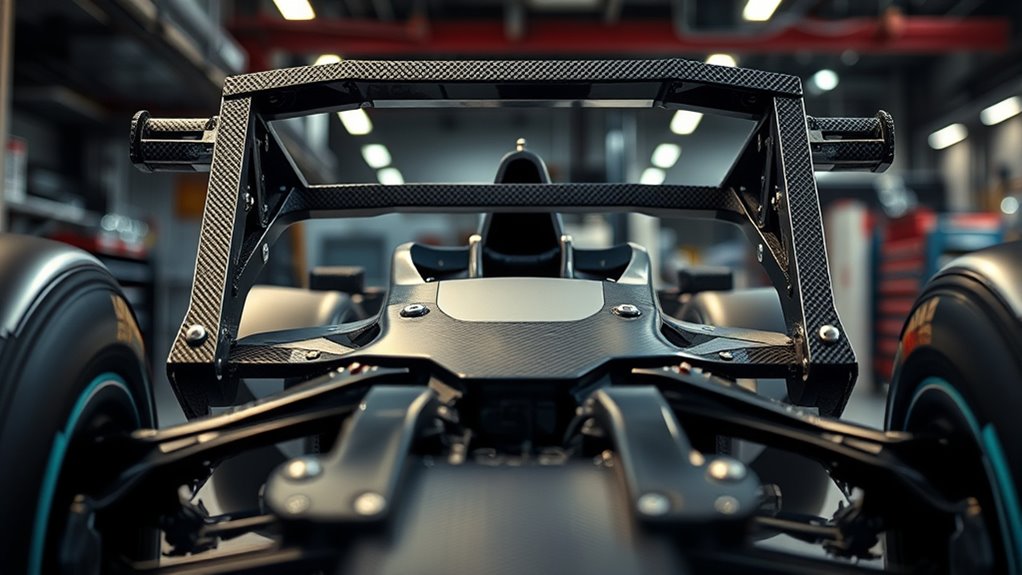
Although it may weigh only about 35 kilograms, the F1 car chassis costs around $707,000 because it’s built from ultra-light carbon fiber layers that make it twice as strong as steel and five times lighter. You’ll find that the monocoque structure at its core supports the entire car, designed to withstand extreme aerodynamic loads and provide exceptional crash resistance.
This use of lightweight materials doesn’t just reduce weight—it guarantees remarkable structural strength essential for driver safety. When you consider the chassis cost, remember that any damage repair can approach $675,000, reflecting how critical and costly these components are to fix.
The carbon fiber layers are meticulously engineered to absorb impacts while maintaining rigidity, making the chassis a foundation of costly safety. So, when you watch an F1 car speeding around the track, know how much effort and expense go into that chassis protecting the driver every lap.
F1 Car Power Unit: Engine Costs Over $18 Million

How much does it take to power a Formula 1 car at the highest level? The F1 engine, combined with hybrid systems, pushes the power unit cost beyond $18 million.
This staggering price covers the internal combustion engine, turbocharger, MGU-K, MGU-H, batteries, and control electronics—each crafted from high-performance materials and refined continuously for peak efficiency.
Teams often pay around €15 million for a customer engine, exceeding regulatory cost caps, which really highlights the power unit’s complexity. Since 2014, the core design hasn’t changed much, but relentless engine refinement keeps performance at its cutting edge.
| Component | Description |
|---|---|
| Internal Combustion Engine | Core power source |
| Turbocharger | Boosts engine output |
| MGU-K | Recovers kinetic energy |
| Batteries | Store energy for hybrid systems |
| Control Electronics | Manage power flow and efficiency |
This investment reflects the advanced engineering behind every F1 power unit.
Intricate Aerodynamics: Front Wings and Floors Explained
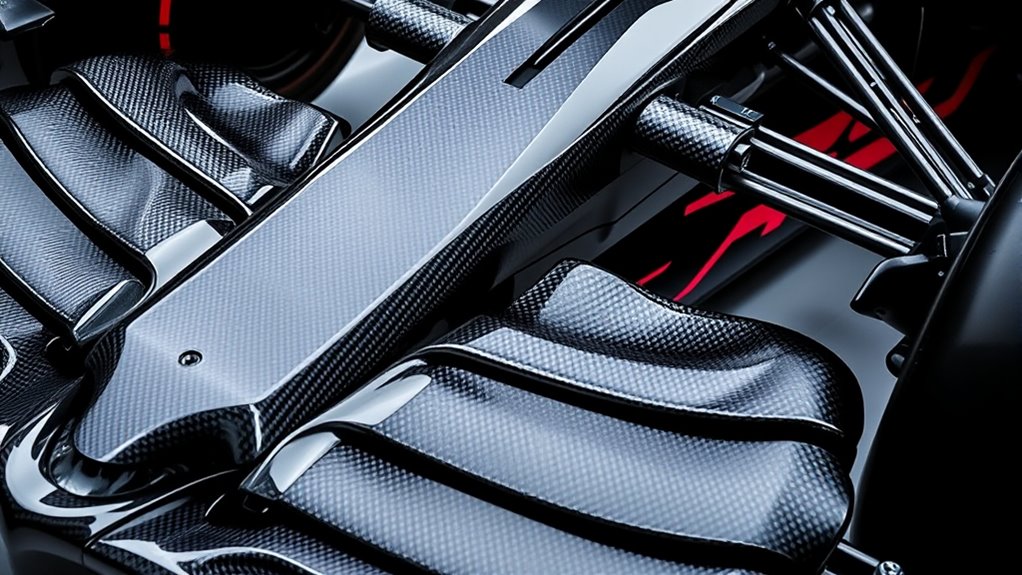
The power unit may deliver immense energy, but it’s the aerodynamics that keep the car glued to the track. The front wing assembly, costing around $141,500, stands out as the most intricate aerodynamic component. Its detailed design manages airflow and generates vital downforce, setting the tone for the car’s performance.
Below, the floor plays an even bigger role, responsible for about 60% of the downforce. Priced near $141,000, its intricate design includes specialized elements in the outer 100mm to optimize airflow and minimize drag.
Alongside these, bargeboards contribute by refining airflow efficiency, all part of the extensive aerodynamic package. Together, these aerodynamic components represent a significant portion of the car’s cost, reflecting constant development and upgrades.
Understanding how these parts work together shows why teams invest heavily in their wing assembly and floor—because controlling airflow and maximizing downforce directly impact lap times and race outcomes.
F1 Car Electronics: Steering Wheels, Hydraulics, and Cost
When you grip an F1 steering wheel, you’re holding a $50,000 piece of technology packed with over 20 buttons, 9 rotary switches, and 6 paddles—all tailored to the driver’s exact preferences. This complex electronics hub houses an ECU from McLaren Applied Technologies, seamlessly managing telemetry and control functions.
Up to 150 sensors feed data through electronic control boxes, enabling real-time performance monitoring. It’s pretty impressive how much tech fits into such a small space.
Hydraulics in the car, costing around $170,000, operate steering, brakes, and other systems with precise fluid pressure control. The steering wheel’s high-end electronic connectors and rapid-release mechanisms let drivers swap it in under five seconds during pit stops.
That quick change is crucial for minimizing downtime when every second counts.
Key components impacting F1 car cost include:
- Customizable steering wheel with integrated ECU and telemetry
- Extensive sensor network relayed via control boxes
- Advanced hydraulics ensuring precise mechanical response
Together, these electronics and hydraulics drive both performance and expense in an F1 car. It’s a perfect example of how cutting-edge tech pushes both speed and cost sky-high.
Hidden Costs: Small Parts That Add Thousands to F1 Car Price
Although small in size, components like wheel bearings, chassis wiring looms, and driveshafts carry hefty price tags that quickly add up. Wheel bearings alone cost around $1,100 each due to their high-performance demands.
Chassis wiring looms push expenses even higher, with prices near £25,000, reflecting their complexity and critical role in car electronics. Driveshafts, priced at about £7,000 each, demand precision engineering to guarantee flawless power delivery.
You might overlook fasteners and connectors, but these small parts are custom-made for safety and reliability, adding more to the overall cost. Every fastener and connector must meet strict standards, preventing failures that could compromise performance or driver safety.
Together, these small parts considerably increase the F1 car’s price, proving that even the tiniest components carry major financial weight. Understanding these hidden costs helps you appreciate the immense investment behind every high-speed lap.
Frequently Asked Questions
How Much Does an F1 Car Really Cost?
An F1 car really costs over $20 million, with the engine alone near $18 million.
You’ll find major parts like the front wing costing over $100,000, and safety features adding thousands more.
It’s wild to think about how much goes into just one car, right? Every piece is seriously high-tech and expensive.
What Is the 75% Rule in F1?
Ever wondered what the 75% rule in F1 means? You have to complete at least 75% of the race distance to be classified and earn points.
This rule makes sure you genuinely compete before the results count. It’s a way to keep things fair and competitive in the sport.
What Is the 90% Rule in F1?
The 90% rule in F1 means you can only reuse up to 90% of last season’s car parts.
You’re allowed to develop just 10% of new components, pushing you to innovate efficiently while controlling costs.
It’s a smart way to keep things fair and make sure teams don’t just keep building entirely new cars every year.
Which F1 Team Sold for $1 Dollar?
You know the Sauber F1 team sold for $1.
You might think it’s shocking, but it’s strategic, it’s symbolic, and it’s smart—saving the team from collapse while keeping its valuable assets and racing license intact.
Conclusion
Think of an F1 car as a masterpiece painting—each brushstroke, from the chassis to the tiniest bolt, adds layers of value you might not see at first glance. Just like a symphony relies on every instrument, this racing marvel depends on costly parts working in harmony.
So, when you see those million-dollar machines roar by, remember: their true price is a complex dance of precision, power, and unseen details that make speed possible. The costs aren’t just about flashy looks or engine size—they include high-tech materials, constant research, and minute engineering tweaks.
In fact, the surprising costs behind how much an F1 car does cost go far beyond the surface. Every component, every upgrade, and every test pushes the boundaries of technology and performance. That’s why these cars are not just expensive—they’re masterpieces of innovation that combine precision, power, and cutting-edge engineering to dominate the track.